
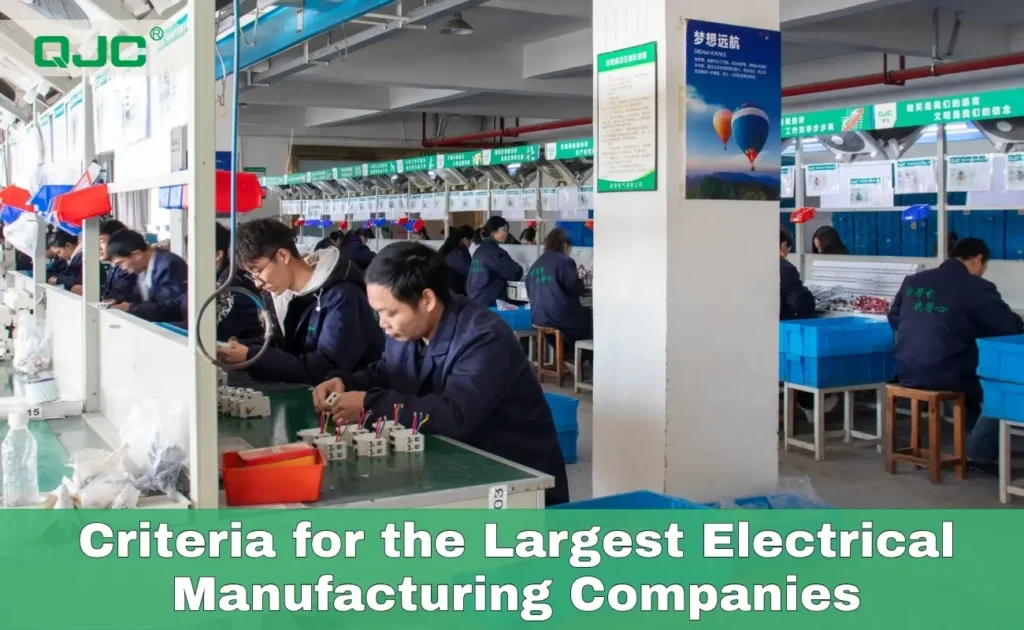
The largest electrical manufacturing companies don’t just produce components; they shape how electrical systems actually perform in real environments. When you look closely, the difference isn’t always in size but in how consistently they deliver under pressure. Many of the top electrical manufacturing companies in the world are recognized not only for scale, but for reliability, engineering depth, and the ability to meet real project demands without overcomplicating solutions.
What Defines the Largest Electrical Manufacturing Companies?
Understanding what defines the largest electrical manufacturing companies goes beyond size alone. The real difference appears in performance, consistency, and how they handle real conditions over time. A few key points make the situation clearer:
- In some cases, large scale only matters when the system behind it can handle sudden demand without breaking consistency.
- Reliability over time tends to reveal more than initial performance numbers ever will.
- Products that behave the same way under stress are often a sign of deeper engineering, not just better materials.
- It’s not unusual to see variation between batches, but controlling that variation is what separates stronger manufacturers
- Many of the top electrical manufacturing companies in world focus more on repeatability than pushing extreme performance.
- Supply chain stability quietly affects outcomes, even when it’s not visible in the final product.
- Adapting to different environments is often more difficult than scaling production itself, and that’s where gaps appear.
- Over-designed solutions don’t always perform better; sometimes simpler designs hold up longer in real use.
- Long-term behavior in the field tends to matter more than results achieved during controlled testing.
What Makes a Top Global Electrical Manufacturer Stand Out?
The distinguishing features of a leading global electrical manufacturer are often not immediately apparent. The real difference usually appears later, once systems start operating under real pressure and conditions. Looking at it practically, these points explain it better:
- Performance Consistency Over Time: Initial stability does not always continue under changing conditions.
- Environmental Adaptability: A design that works in one setting may behave differently in another.
- Long-Term Reliability: Extended use often reveals issues that short testing cannot detect.
- Simplicity in Design: Fewer complexities can reduce the chances of failure.
- Variation Control: Managing production variation can be more important than maximizing peak output.
- Focus on Repeatability: Leading manufacturers prioritize consistent results over extreme performance.
- Supply Chain Stability: Disruptions can impact consistency even if products appear identical.
- Field Performance Importance: Real-world results matter more than technical specifications.
- Performance Over Time: The true difference appears during operation, not at installation.
Key Capabilities to Look for in Leading Electrical Brands:
In most cases, you don’t notice the real difference between brands right away, it starts to show through a few practical points once the product is actually in use:
- Real performance: Some products look fine at the start, but once the load changes, they don’t feel as stable as expected
- Consistency: Two units that are supposed to be identical can still behave slightly differently in real use
- Design details: Small choices in design can affect performance in ways that only show up after some time
- Durability: You don’t really see durability on day one; it becomes clear after repeated use
- Stability: In many cases, stable performance matters more than pushing the product to its highest limit
- Unexpected situations: The real test is how the product reacts when something doesn’t go as planned
- Simplicity: Simpler designs are sometimes easier to rely on because there’s less that can go wrong
- Long-term behaviour: What happens after months of use is usually more important than initial results
This is often where the largest electrical manufacturing companies stand out, because their products tend to behave the same way even when conditions are not ideal.
Read More: How to Choose the Correct Circuit Breaker for Your Project?
How to Choose the Right Electrical Partner for Your Project?
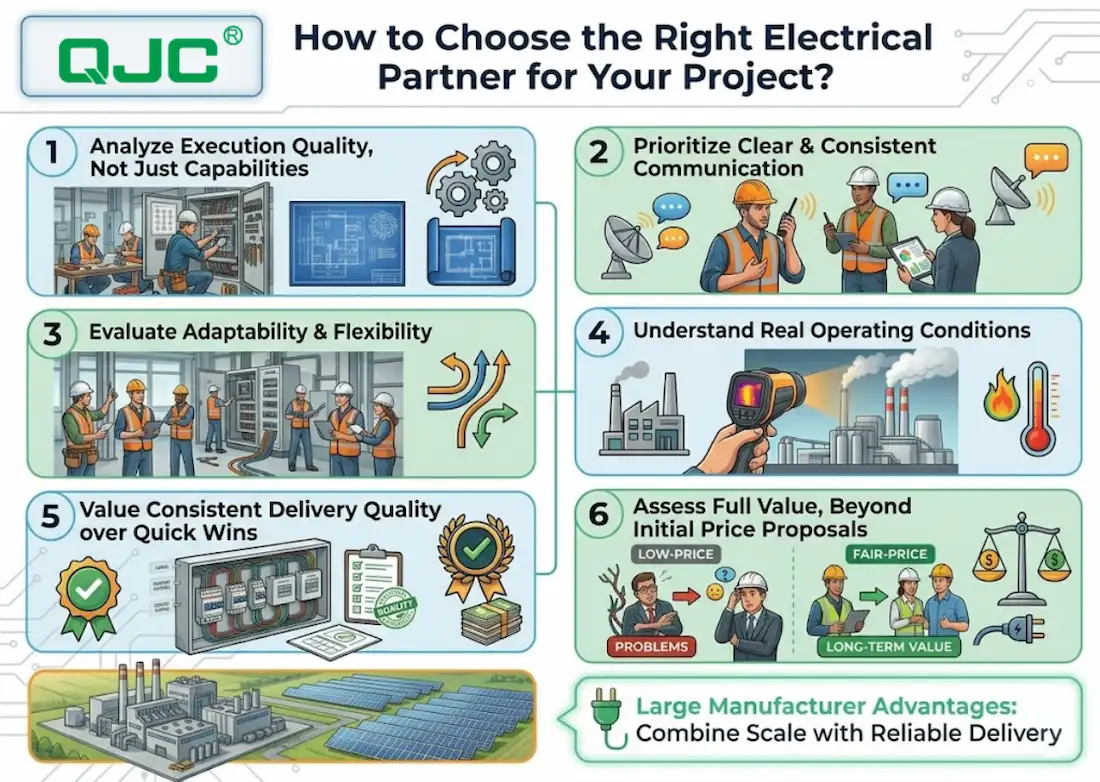
Choosing the right electrical partner usually becomes clearer once you think beyond proposals and focus on how the work actually runs on the ground. In most projects, the real difference doesn’t show at the beginning, but during execution. Looking at a few simple, practical points can help make the picture more realistic:
- A strong portfolio doesn’t always mean the team can deal with unexpected changes smoothly.
- Similar technical capabilities can still result in noticeable differences in execution quality.
- Clear and consistent communication makes handling on-site adjustments much easier.
- Understanding real operating conditions helps reduce avoidable design problems.
- Timelines often change depending on how the work is managed in practice.
- Flexibility becomes important when plans don’t go exactly as expected.
- Consistent delivery quality is usually more valuable than completing work quickly once.
- Price differences don’t always reflect actual performance in real use.
- Larger manufacturers often distinguish themselves by combining scale with reliable delivery.
Why QJC Stands Out Among the Largest Electrical Manufacturing Companies?
The largest electrical manufacturing companies are compared by size, but that doesn’t always reflect how products behave in real conditions. What makes QJC stand out is not pushing limits but keeping performance stable even when the environment is not ideal.
Over time, that approach becomes easier to recognize. Some products need adjustment; others don’t. Those who maintain their behavior without much attention tend to be the ones people rely on, especially when systems are expected to run without interruption.
Core Advantages of QJC Large Scale Electrical Manufacturing:
QJC’s manufacturing strength becomes clear through how its systems maintain control, consistency, and reliability even at high production volumes:
- High-volume consistency: Ability to maintain stable performance across large production runs without noticeable variation.
- Advanced process control: Tight control over every production stage to ensure uniform output and reduce deviations.
- Material reliability: Careful material selection and handling to keep behaviour consistent across different batches.
- Process discipline: Well-structured production workflows that keep operations stable under continuous demand.
- Scalable efficiency: Smooth scaling of production without compromising quality or performance
- Continuous monitoring: Real-time tracking of production parameters to quickly detect and correct any variation.
- Balanced production speed: Managing production pace to maintain both efficiency and predictable results.
- Consistent performance at scale: This is where largest electrical manufacturing companies stand out, and QJC maintains stable results even under high demand.
Read More: How to choose a device used to protect an electrical circuit?
Key Electrical Products and Solutions Provided by QJC:
In real applications, the value of a product usually appears in how it fits into the system without adding unnecessary complexity. Each solution tends to serve a specific role, depending on how the setup is designed and how it is expected to perform over time.
This type of breaker is often used where direct access isn’t always possible. Being able to control and monitor it remotely changes how systems are managed. In setups where the largest electrical manufacturing companies focus on flexibility, this kind of solution becomes more practical over time.
Solar systems can become difficult to manage if connections are not organized properly. A combiner box helps keep everything grouped in a clear way, especially in outdoor conditions. Over time, that structure reduces the chance of small issues affecting overall system performance.
DC protection requires a different kind of response compared to standard systems. This fuse is designed to react quickly without adding complexity. In many cases, that fast response is what prevents damage from spreading beyond a single point.
In some situations, stopping current isn’t enough, and clear isolation becomes necessary. This is where this switch is used. It provides a visible disconnection point, which is important during maintenance. This approach is commonly seen in systems developed by the largest electrical manufacturing companies.
Read More: Distribution Box (DB Box) : Complete Guide to Electrical Power Distribution and Protection.
Conclusion:
Working with largest electrical manufacturing companies doesn’t always show its value straight away. Things become clearer later, once systems have been running for some time. Some products stay stable, others start to drift slightly, and that’s usually where the difference appears. It’s not really about having more features; it’s about how things behave when conditions are not perfect. If you’re trying to find something that just works without overthinking it, you can look at Qinjia-mcb. Having something you don’t have to constantly check is ultimately what matters.
Need a trusted electrical manufacturer to meet your high-volume demands without compromising quality? Send an inquiry via our Contact Us page, chat with us on WhatsApp, or simply email info@dodgerblue-peafowl-108665.hostingersite.com to start discussing your project needs.
FAQs:
What is the exact scope of electrical manufacturing?
It usually covers more than just producing components. It includes design, testing, and making sure products can handle real operating conditions without issues.
How do I choose the right electrical manufacturing partner for my project?
It often depends on how well the supplier understands your actual needs, not just what’s written in specifications.
What should I look for when partnering with a large-scale electrical manufacturer?
Consistency matters more than promises. You want products that behave the same way over time, not just perform well once.




Leave a Reply