A device used to protect an electrical circuit is something most people don’t think about until a problem actually happens. In reality, it’s what keeps systems running safely in the background. Today, devices are used to protect an electrical circuit in everything from small homes to larger setups, and choosing between the different types of circuit protection devices can quietly make a big difference over time.
What Is the Device Used to Protect an Electrical Circuit?
A device used to protect an electrical circuit is one of those things you don’t really pay attention to at first. It just sits there, doing its job. But once something goes wrong, it suddenly becomes the most important part in the whole setup.
Devices are used to protect an electrical circuit by reacting when the current stops behaving normally. Too much load, a sudden fault, something unexpected—the device steps in. It cuts the flow, or limits it, before things become worse than they should.
Different Types of Devices Designed for Circuit Protection:
Before the comparison, it’s worth noting that a device used to protect an electrical circuit isn’t one standard solution. The different types of protection devices are designed for specific situations, depending on how the system actually works in real use.
| Aspect | Description |
| Fuse | A fuse is a straightforward device. Once the current goes too high, it melts and cuts the circuit. It does the job well, but you don’t get to reuse it after that. |
| Circuit Breaker | Works in a similar way, but feels more practical in daily use. When it trips, you can reset it instead of replacing anything, which is why it’s so common. |
| Residual Current Device (RCD) | This one is more about safety than equipment. It looks for small imbalances in current and cuts power quickly to reduce the risk of electric shock. |
| Miniature Circuit Breaker (MCB) | You’ll usually see these devices in homes. It handles both overload and short circuit situations without much effort, and resetting it is straightforward. |
| Moulded Case Circuit Breaker (MCCB) | Used when things get bigger. It can handle higher currents and gives more control over how and when it trips. |
| Surge Protection Device (SPD) | This device deals with sudden voltage spikes. It aids in safeguarding delicate equipment from damage that can occur in an instant. |
| Combined Systems | In many setups, more than one device used to protect an electrical circuit is used together, simply because one type alone doesn’t cover every possible issue. |
Read More: Comprehensive Guide to Electrical Symbols: From Fuses to Circuit Breakers.
How Does a Protection Device Secure Your Electrical System?
Usually, a system stays stable because a device used to protect an electrical circuit steps in early, reacting in time before things get worse and stopping small issues from turning into bigger damage.
- It keeps observing the current in the background, not actively interfering unless something changes.
- It responds quickly when the flow shifts beyond what is expected, not instantly every time, but fast enough to limit risk.
- It can stop the current or reduce it, depending on how serious the situation is.
- Occasionally it only affects one section, which allows the rest of the system to keep running.
- Heat build-up is reduced, and that alone prevents many common electrical issues.
- Minor irregularities are handled early, before they develop into faults that are harder to manage.
- Systems with changing loads benefit more, because the response adapts to variation rather than fixed behavior.
- Over time, components experience less stress, which improves durability and consistency.
Read More: Distribution Box (DB Box) : Complete Guide to Electrical Power Distribution and Protection.
How to Choose the Right Protective Device for Your Project?
A device used to protect an electrical circuit is not something you just pick and move on, because the right choice usually depends on how the system actually behaves once it’s running, not only on how it looks on paper.
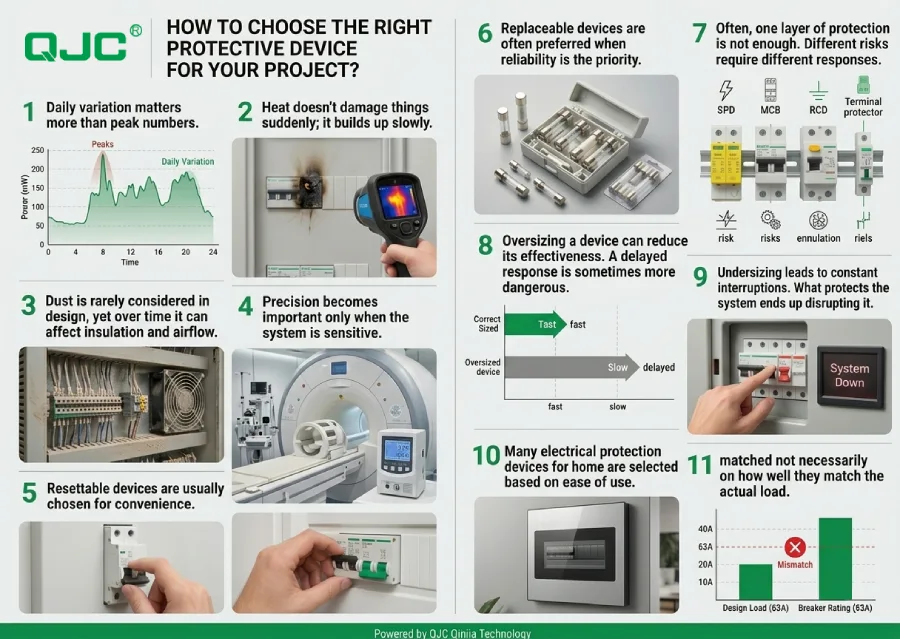
- Daily variation matters more than peak numbers. A system that fluctuates needs flexibility, not just capacity.
- Heat doesn’t damage things suddenly; it builds up slowly. That’s why it’s often ignored until it becomes a real issue.
- Dust is rarely considered in design, yet over time it can affect insulation and airflow in ways people don’t expect.
- Precision becomes important only when the system is sensitive. Not every setup needs that level of control.
- Resettable devices are usually chosen for convenience, especially in environments where interruptions are expected.
- Replaceable devices are often preferred when reliability is the priority, even if they require more effort after activation.
- Often, one layer of protection is not enough. Different risks require different responses.
- Oversizing a device can reduce its effectiveness. A delayed response is sometimes more dangerous than no response at all.
- Undersizing leads to constant interruptions. What protects the system ends up disrupting it instead.
- Many electrical protection devices for home are selected based on ease of use, not necessarily on how well they match the actual load.
Read More: How to Choose the Correct Circuit Breaker for Your Project?
Essential Safety Standards Met by QJC Electrical Protection Devices:
In real systems, safety standards don’t always reflect what actually happens during operation. This issue becomes clearer when a device used to protect an electrical circuit responds under fault conditions, as shown in the following points.
- Standards like IEC set limits, but they don’t always reflect how devices behave under mixed or changing loads.
- Devices may respond differently once the load profile moves away from steady conditions.
- Temperature tends to influence performance more than expected, especially over longer operating periods.
- Contact design plays a role in how stable the interruption process remains under high fault levels.
- Repeated operation can slightly shift response timing, even if the device still works.
- Protection coordination affects whether a fault stays local or spreads across the system.
- In some cases, delayed tripping is intentional to maintain system balance.
- Small manufacturing tolerances can show up only when the device is under stress.
- Insulation properties may change gradually, even without immediate failure.
How QJC Manufactures Reliable Devices to Protect Electrical Circuits?
When you look closer at protection devices, the difference is not just in type but in real behavior. The distinction becomes clearer when a device used to protect an electrical circuit responds under fault conditions.
- A fuse clears fault current by melting its element, and its response depends on time–current characteristics rather than a fixed limit
- Circuit breakers rely on thermal and magnetic mechanisms, which means their reaction can vary between overload and short circuit conditions
- In high fault scenarios, breaking capacity becomes critical, since not all devices can safely interrupt large currents
- DC protection behaves differently because there is no natural zero crossing, so arc suppression becomes more complex
- Residual current devices measure imbalance between conductors, not total current, which changes how they detect faults
- Selectivity between devices affects whether only one section trips or the whole system shuts down
- Coordination settings can influence system stability, especially when multiple devices are installed in sequence
- Temperature and ambient conditions can shift operating thresholds slightly over time
- Mechanical wear from repeated operation may change response accuracy, even if the device still functions.
Conclusion
A device used to protect an electrical circuit is easy to ignore when everything is working. Then something small happens, and it suddenly matters. The choice doesn’t have to be perfect. It just needs to suit how the system is actually used. Some setups need more control; others don’t. That’s fine. If you’re comparing options, have a look at Qinjia-mcb and see what feels right for your setup. In the end, it’s not about features on paper. It’s about having something that behaves the way you expect when things aren’t ideal.
Need help deciding on the right device for your project? Send an inquiry via our Contact Us page, chat with our team directly on WhatsApp, or simply email us at info@dodgerblue-peafowl-108665.hostingersite.com to receive customized technical guidance for your setup.
FAQs:
What is the most common device used to protect a circuit?
The most common device used to protect an electrical circuit is a circuit breaker, mainly because it can stop the current when needed and then be reset easily without needing replacement.
What is the difference between a fuse and a circuit breaker?
A fuse works once and needs to be replaced after it operates, while a circuit breaker can be reset and used again, which makes it more practical in many situations.
What happens if an electrical circuit does not have a protective device?
Without a device used to protect an electrical circuit, faults can continue without control, which may lead to overheating, damage to equipment, or even serious safety risks over time.





Leave a Reply