What size breaker for solar panels is usually answered too quickly, often by looking at one current figure and stopping there. In real installations, breaker sizing is tied to continuous load behaviour, conductor protection, inverter characteristics, and the difference between AC-side and DC-side duty. Solar circuits do not always behave like ordinary branch circuits, especially where long operating hours and elevated temperatures are involved.
What Size Breaker for Solar Panels Do You Need?
To answer what size breaker for solar panels correctly, you need to link the breaker rating to real PV current, cable capacity, inverter output, and operating temperature, as you’ll see in the points below:
- Rated Circuit Current: Start from the maximum current expected from the PV string or inverter output, not from the panel wattage alone.
- Continuous Load Margin: Solar circuits can operate for long periods, so the breaker should normally allow safe continuous current without nuisance tripping.
- Cable Ampacity First: The breaker must protect the cable; never choose a breaker rating higher than the conductor can safely carry.
- DC Side Protection: Use a DC-rated breaker where the circuit carries PV string current, because DC fault arcs are harder to extinguish than AC arcs.
- AC Side Protection: Match the breaker to the inverter’s rated AC output current and the distribution board design.
- Temperature Derating: Rooftop enclosures can become hot, reducing breaker performance and increasing unwanted trips.
How to Calculate the Correct Breaker Size for Your Solar System?
To calculate what size breaker for solar panels, don’t look at panel wattage alone; the safer route is to follow current, cable, and breaker duty, as you’ll know from the points below:
- Breaker location: DC string protection is sized from panel current, while the AC breaker is sized from the inverter output.
- Panel Isc value: Use short-circuit current from the module label, because PV faults are judged around this number, not only the normal working current.
- Parallel strings: Current adds together; three parallel strings at 10A each should be treated as 30A before safety margin.
- Series strings: Voltage increases, so the breaker needs the right DC voltage rating, not just the right amp rating.
- Safety factor: NEC 690.8 starts with PV short-circuit current to calculate maximum circuit current.Further factors may apply for continuous load, conductor ampacity, overcurrent device rating, and circuit location.
- Cable limit: The breaker must stay below the corrected cable ampacity after heat, conduit fill, and installation derating.
Read More: How to Choose the Correct Circuit Breaker for Your Project?
Applying the 125% Rule for Safe Solar Breaker Sizing:
Applying the 125% rule helps answer what size breaker for solar panels without choosing a breaker that is too close to the real operating current, as you’ll know from the points below:
- Start with Isc: Use the module short-circuit current, because PV protection is normally based on the highest current the panel can deliver under fault-style conditions.
- Add Parallel Strings: If one string is 10.8A and there are three parallel strings, calculate from 32.4A before selecting the breaker.
- Apply 125% Once: NEC 690.8 commonly defines PV maximum circuit current as parallel Isc multiplied by 125%.
- Check Continuous Duty: Inverter output breakers are also often sized based on the maximum output current multiplied by 125%.
- Protect the Cable: The breaker must not exceed the cable’s corrected ampacity after heat, conduit fill, and installation derating.
Matching Your Breaker Amperage to the Solar Inverter Output:
Matching the breaker to inverter output helps answer what size breaker for solar panels on the AC side, where the load is driven by the inverter’s maximum exported current, as you’ll know from the points below:
- Inverter Nameplate Current: Use the maximum AC output current, not the solar array wattage, because the inverter limits what reaches the AC board.
- 125% Sizing Check: Many PV designs size the inverter breaker from maximum output current × 1.25 for continuous operation.
- Voltage Matters: A 5kW inverter at 230V carries about 21.7A before safety margin; the same power at a different voltage changes the current.
- Cable Coordination: The breaker must suit the cable after heat, grouping, conduit fill, and installation derating.
- Breaker Limit: Do not choose a higher amp rating just to stop tripping; it may leave the AC cable under-protected.
- Calculator Use: A solar panel breaker calculator helps estimate amperage, but QJC breaker selection should confirm rated current, breaking capacity, pole count, and AC/DC suitability.
Read More: Distribution Box (DB Box) : Complete Guide to Electrical Power Distribution and Protection.
The Main Differences Between AC and DC Solar Circuit Breakers:
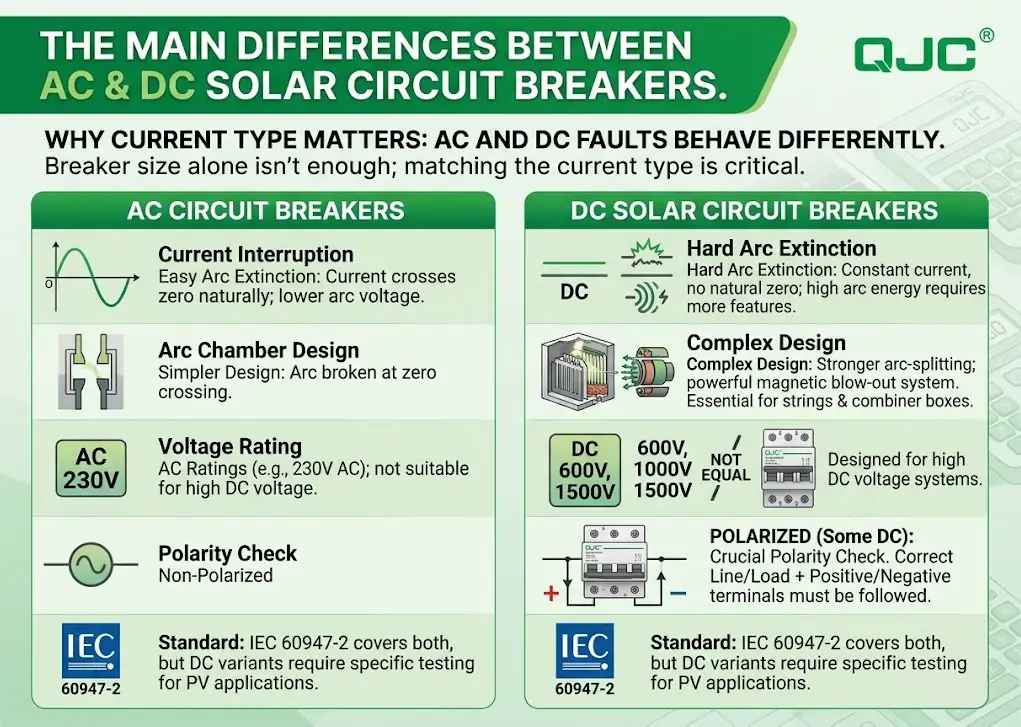
Knowing what size breaker for solar panels is not enough; the breaker must also match the current type, because AC and DC faults behave differently, as you’ll know from the points below:
- Current Interruption: AC current crosses zero naturally, while DC current does not, so DC arcs are harder to extinguish safely.
- Arc Chamber Design: DC solar breakers need stronger arc-splitting and magnetic blow-out design, especially in PV strings and combiner boxes.
- Voltage Rating: A breaker marked 230V AC is not automatically safe for 600V, 1,000V, or 1,500V DC solar circuits.
- Polarity Check: Some DC breakers are polarised, so line/load direction and positive/negative terminals must be followed during installation.
- Standard Selection: IEC 60947-2 covers low-voltage circuit breakers and includes products used in PV protection up to high DC ratings.
How High Temperatures Affect Your Solar Breaker Choice?
Heat can change what size breaker for solar panels you choose, because the breaker is not working in a clean lab condition; it is often inside a small outdoor box, near hot cables, under direct sun, as you’ll know from the points below:
- Rooftop Reality: A breaker inside a PV combiner box may face higher heat than the weather reading, especially on metal roofs or poorly shaded areas.
- Lower Carrying Capacity: Heat makes the breaker less comfortable carrying its full rated current for long periods.
- Cable First: If the cable loses ampacity in high temperature, the breaker size must follow the cable, not the installer’s preferred amp rating.
- Trip Behaviour: A hot breaker may trip earlier, even when the inverter and panels are not actually faulty.
- Terminal Heating: Loose screws, weak crimping, or small contact areas become worse in hot PV boxes.
Essential IEC Safety Standards for Solar Circuit Protection:
IEC standards make what size breaker for solar panels a safer engineering decision, because the breaker must be tested for the voltage, current, and fault duty found in PV systems, as you’ll know from the points below:
- IEC 60947-2: Used for low-voltage circuit breakers, including ratings up to 1,000V AC and 1,500V DC.
- PV DC Duty: Choose breakers tested for DC interruption, not ordinary AC-only breakers.
- IEC 60269-6: Covers fuse-links used for protecting PV strings and PV arrays up to 1,500V DC.
- IEC 61643-31: Applies to surge protective devices on the DC side of PV installations up to 1,500V DC.
- IEC 60898-1: More common for household-style AC circuit breakers, so it should not be confused with PV DC protection.
- Breaking Capacity: The device must clear fault current without contact welding, casing damage, or unsafe arcing.
- QJC Selection: QJC PV protection should be checked by IEC rating, DC voltage, current rating, pole number, and installation point.
Read More: Which Brand MCB Is Best? Standards to Select.
Why QJC Is the Best Choice for Solar PV Circuit Protection?
QJC makes the question of what size breaker for solar panels easier to handle because the selection is not only about amps; it is about using protection devices built for real PV conditions, as you’ll know from the points below:
- PV Product Range: QJC covers solar-side protection parts such as DC miniature circuit breakers, DC MCCBs, DC surge protection, PV fuses, solar connectors, and photovoltaic DC switches.
- DC Voltage Suitability: QJC solar protection includes devices used for DC systems up to 1,000V in PV lines, which matters for string and combiner protection.
- System Matching: Installers can match breaker rating with string current, inverter input, cable size, and combiner box layout.
- Fault Protection: The aim is not only disconnection, but safe interruption of overload and short-circuit current.
- Complete Board Design: QJC also supplies distribution boxes, fuses, SPDs, relays, contactors, cables, and control parts, helping contractors build coordinated PV panels from one product source.
Read More: Your Easy Guide to DC Surge Protective Device.
Key Types of Circuit Breakers for Solar Panels Provided by QJC:
Choosing what size breaker for solar panels becomes easier when each protection device is placed in the right part of the PV circuit, as you’ll know from the points below:
- DC MCB: Best for string circuits and smaller DC branches where the current is limited, but the voltage can still be high.
- DC MCCB: A better fit for combiner outputs and larger PV feeders, not only because of higher current, but also because it gives more room to match the rest of the protection system, site conditions, and the fault current the breaker may need to interrupt.
- PV Fuse: Protects one weak or faulty string from reverse current coming from the other parallel strings.
- DC Surge Protector: Added before the inverter to reduce damage from lightning surges and switching spikes.
- PV DC Switch: Used for isolation, not overload protection, so installers can disconnect the array before service.
- Type B RCD: Useful when DC leakage may appear and standard leakage protection may miss it.
QJC lists DC MCBs, DC MCCBs, DC SPDs, Type B RCDs, PV fuses, connectors, and photovoltaic DC switches for solar PV systems.
Conclusion:
Choosing what size breaker for solar panels is not just a simple amp rating; it is a safety decision based on PV current, inverter output, cable ampacity, DC voltage, heat derating, and fault interruption duty. A well-sized breaker helps prevent nuisance tripping, cable overheating, inverter damage, and unsafe DC arcing. For installers and solar contractors who need reliable PV circuit protection, qinjia-mcb offers QJC products that support safer system design, from DC breakers and PV fuses to surge protection and isolation switches.
For reliable solar PV protection and expert technical support, visit our Contact Us page, reach out directly via WhatsApp, or email sales@qinjia-mcb.com to discuss your specific project needs with QJC today.
FAQs:
How do you calculate the continuous load for a commercial solar circuit breaker?
Take the current the circuit will carry for long hours, then leave a safety margin and make sure the cable can handle it without heating.
What happens to a solar PV system if the circuit breaker is undersized?
It will keep tripping on bright days, so the system loses production even though there may be no real fault.
Why do large solar installations require specialised DC circuit breakers?
Because DC current is stubborn when it arcs, especially at high voltage, so it needs a breaker made to break it safely.
What type of circuit breaker is used for solar panels?
Use DC breakers on the panel side before the inverter, and AC breakers after the inverter. For larger solar systems, you may also need MCCBs, PV fuses, and surge protection to keep the circuit safer.



Leave a Reply