
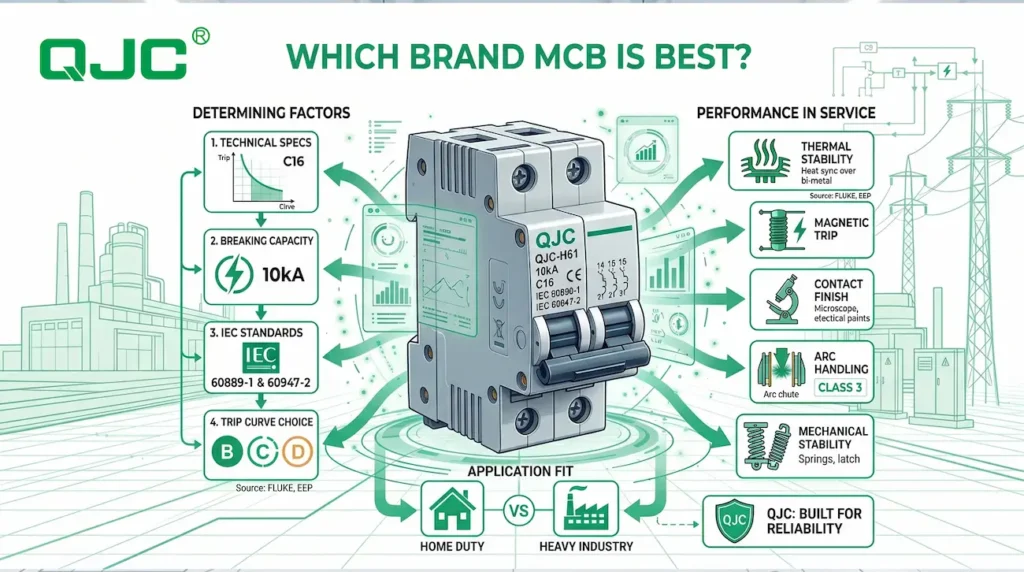
At first glance, many MCBs look nearly identical, and that is exactly what makes the choice less obvious than it seems. Which brand mcb is best usually becomes clearer only when the breaker is placed in service and expected to respond properly under real electrical conditions. Some units appear acceptable in the catalogue, yet the difference starts to show under load, during repeated switching, or when fault protection is actually needed. That is the point where product quality stops being a claim and starts becoming visible in practice.
Why the Manufacturer Behind Your Miniature Circuit Breaker Matters?
Two MCBs may look the same at first, but the real difference often starts to show once the breaker is exposed to actual load, heat, and fault conditions. That is where the technical details below become much more important:
- Thermal element behavior: If the bimetal is not calibrated well, overload response starts to drift from what the circuit really needs.
- Magnetic trip response: Short-circuit release has to act in the right range, otherwise protection becomes either too late or too unstable.
- Contact finish: Small differences in contact surface quality can raise resistance, and that extra resistance turns into heat.
- Arc handling: A breaker that clears the arc properly usually keeps its internal parts in better condition after interruption.
- Mechanical stability: Springs, latch parts, and moving contacts need to stay consistent after repeated switching.
- Material durability: Housing supports, insulation parts, and carriers should keep their form even after thermal cycling.
- Production control: Good manufacturing shows up when one breaker behaves much like the next, not when only one sample performs well.
Read More: Criteria for the Largest Electrical Manufacturing Companies.
How to Determine Which Brand MCB Is Best for Your Project?
The right answer usually depends less on the name and more on whether the breaker actually fits the electrical duty it will see. That is where which brand mcb is best becomes easier to judge in a technical way:
- Fault level: The MCB has to interrupt the prospective short-circuit current available at that point in the system; otherwise, the rating means very little.
- Trip curve choice: B, C, and D curves are not interchangeable; the right curve depends on how much inrush current the load draws at start-up.
- Thermal behavior: Ambient temperature and enclosure heat can change breaker performance, so derating is not a small detail in dense boards.
- Coordination: The breaker should work sensibly with upstream protection, not trip in a way that takes down more of the system than necessary.
- Standards basis: good comparison starts with IEC alignment before anyone starts calling a product one of the best MCB brands in the world.
- Application reality: A strong industrial choice is not always the same as what people call the best mcb brands in world in general discussion.
Read More: How to Choose the Correct Circuit Breaker for Your Project?
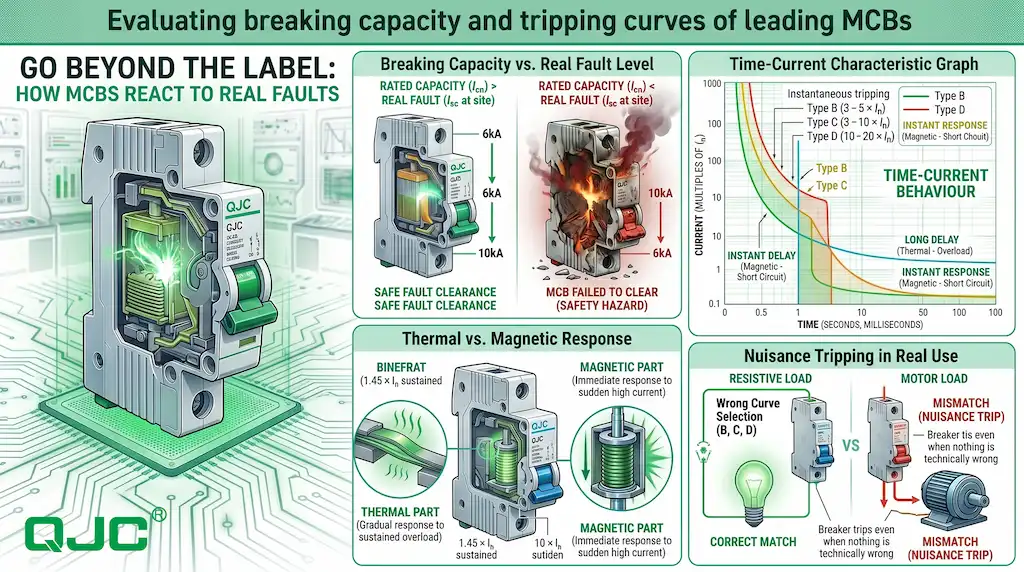
Evaluating the Breaking Capacity and Tripping Curves of Leading MCBs:
Before deciding which brand mcb is best, it helps to look beyond the label and focus on how the breaker reacts when a real fault happens, not just under ideal conditions
- Breaking capacity vs real fault level: The interrupting rating (Icn) only makes sense when compared with the actual fault level on site, because if it’s lower than the available fault current, the breaker may not clear the fault safely.
- Time–current behaviour: It’s not just about tripping, it’s about timing; small overloads are allowed briefly, but short circuits need an almost instant response.
- Curve selection (B, C, D): Choosing the wrong curve often shows up in practice, especially with loads that have inrush current like motors, where the breaker trips even when nothing is technically wrong.
- Thermal vs magnetic response: The thermal part reacts gradually to sustained overload, while the magnetic part reacts immediately to sudden high current
- Nuisance tripping in real use: In many cases, frequent tripping comes from a mismatch between the curve and the load, not from a problem with the breaker itself.
Read More: How to choose a device used to protect an electrical circuit?
The Role of IEC Standards in Defining the Reliability of an MCB Brand:
At first, many MCBs can appear similar enough in rating and appearance. The difference becomes easier to judge once you look at the standard behind the device and what that standard is actually testing:
- IEC 60898-1: This standard is mainly used for household and similar installations, so it gives a baseline for safety, tripping behavior, and basic breaker performance in that type of duty.
- IEC 60947-2: This one is more relevant where the electrical duty is heavier, the fault level is higher, and the installation is closer to industrial practice.
- Breaking duty: Standards matter because interruption performance is not judged by appearance; it is judged by whether the breaker can clear fault current safely.
- Trip verification: A serious standard checks whether the breaker opens within the intended operating range instead of drifting too early or too late.
- Temperature rise: Thermal limits help show whether the breaker can stay stable during normal service without hidden overheating.
- Endurance testing: Repeated operation is part of reliability, so a good standard looks beyond one-time performance.
- Application fit: The standard behind the breaker often says more about product suitability than the label on the front.
Read More: How to Choose Best Circuit Breaker for Air Conditioner?
Assessing Warranty and Supply Chain Stability for B2B Electrical Projects:
It’s expected that many teams prioritize ratings first. But once the project is running, replacement, support, and stock continuity start to matter just as much:
- Warranty scope: It should say clearly what counts as a product failure, what is excluded, and how replacement is handled.
- Claim speed: In a running site, a slow warranty process can cost more than the failed breaker itself.
- Batch continuity: New stock should stay close enough to earlier units in behaviour, dimensions, and fit.
- Technical substitution: Support should help when the original unit is no longer available and an equivalent is needed.
- Source traceability: In B2B supply, knowing exactly where the breaker came from is part of risk control.
- Lifecycle support: This is often where a best breaker brand proves itself after the sale.
- Project reality: It is also where which brand mcb is best becomes easier to judge in real use.
Read More: Which Company Circuit Breaker is Best for Projects?
Why QJC Delivers the Best MCB Solutions for Heavy Industries?
In heavy industrial use, the breaker typically reveals its true difference when subjected to heat, repeated switching, and higher electrical stress. That is where the technical points below become much more important:
- Thermal margin: In dense industrial boards, nearby heat affects trip behavior, so the breaker has to stay stable when the enclosure is already running warm.
- Contact pressure: If contact force drops too easily with use, resistance rises, and that extra resistance turns into heat exactly where you do not want it.
- Arc chamber design: Under fault clearing, the arc has to be split and driven out fast enough to limit contact erosion and internal damage.
- Magnetic release control: Heavy-duty loads can produce a sharp current rise, so the instantaneous trip has to act firmly without becoming erratic.
- Mechanical retention: Latch parts, springs, and moving contact carriers need to keep their alignment after repeated operation.
- Material endurance: Housing supports and insulation parts must hold their shape under thermal cycling, not just during first installation.
- It also shows why which brand mcb is best for home is a very different question, because domestic duty is usually lighter and less demanding than industrial service.
- For heavier applications, QJC stands out by focusing on stable behavior in service, not just acceptable figures on paper.
Conclusion:
In practice, which brand mcb is best is not answered by branding, price, or how familiar the product looks in a catalog. The answer usually becomes clearer when the breaker is judged in service, where trip accuracy, thermal behavior, contact durability, and consistency from one unit to the next begin to matter. That is why serious selection is usually tied to operating conditions, fault level, and long-term panel reliability rather than broad claims. For buyers who need an option built around real electrical duty,Qinjia-mcb is worth considering, especially where stable protection matters more than surface-level comparison.
Now that you know the strict engineering standards required to determine which brand mcb is best, don’t compromise on your panel’s safety. Secure IEC-compliant, high-volume MCBs for your heavy-duty projects by consulting our engineering team today via Contact Us, WhatsApp, or info@qinjia-mcb.com.
FAQs:
What makes an MCB brand reliable for commercial and industrial installations?
Once installed, a reliable MCB brand consistently performs the same way. Good fault handling, stable trip behavior, and consistent quality from one unit to another matter more than the name itself.
How do I verify the safety certifications of a miniature circuit breaker manufacturer?
The easiest way is to look for clearly stated standards on the product or in the technical documents, then check whether those approvals are real and current.
Why is tripping curve accuracy crucial when selecting an MCB brand?
The breaker must respond at the appropriate time. If it trips too early, it causes unnecessary interruption. If it trips too late, the system may stay exposed longer than it should.





Leave a Reply