
How to choose the correct circuit breaker is usually treated like a simple step, but it rarely is. In real projects, things don’t always match the textbook. Loads vary, conditions change, and small mistakes show up later. That’s why a clear calculation for selecting a circuit breaker matters. Following iec standard circuit breaker ratings gives a reference, but knowing how to choose the right circuit breaker comes from understanding how the system actually behaves.
What are Circuit Breakers and How They Work?
A circuit breaker is basically there to cut the power when something is not right. Not more than that. It stays closed during normal operation, and once the current goes beyond a certain point, it trips. That’s the simple idea behind how to choose the correct circuit breaker in any system.
Inside, the behavior is split into two parts. One reacts slowly when the current is slightly higher than normal for some time. The other reacts instantly when there’s a short circuit. You don’t see this happening, but that’s what controls when the breaker trips.
In real systems, the issue is not what the breaker does, but how it reacts compared to your load. If it trips too early or too late, it may present a challenge. That’s where knowing how to choose the correct circuit breaker actually matters.
Common Types of Circuit Breakers:
| Insight | Details |
| MCB is usually what you see in homes and small panels; it handles basic loads like lighting and sockets without complexity. | An MCCB is the step up, used when loads get heavier and you actually need some control over trip settings. |
| ACB is not something you casually use; it sits in main panels where fault levels are high and reliability matters more. | VCB is mainly found in medium-voltage setups, especially where arc handling needs to be clean and consistent. |
| The real difference between them shows up during faults, not normal operation. | Each one is built around specific IEC standard circuit breaker ratings, not just current numbers. |
| You don’t jump into calculations for selecting circuit breakers before deciding the type. | Using MCB in an industrial setup is a common but serious mistake. |
| Even if two breakers have the same rating, they won’t behave the same under stress. | If you’re thinking about how to choose the right circuit breaker, type comes first, always. |
Read More: Comprehensive Guide to Electrical Symbols: From Fuses to Circuit Breakers.
How to Choose the Correct Circuit Breaker?
- First thing, don’t trust paper values blindly; real load current on-site is often different from what’s written in the design.
- Look at the load itself; a motor will behave very differently compared to heaters or simple resistive loads.
- Take the running current and give it a small margin, not too high, just enough to avoid unnecessary trips.
- Fault current matters more than people think; many wrong selections fail only during short circuit events.
- Always make sure the breaking capacity is higher than the available fault level; otherwise, the breaker won’t survive.
- IEC standard circuit breaker ratings are not just formalities; they define where the device actually works safely.
- Startup conditions can mislead you, especially with high inrush currents.
Key Electrical Parameters for Correct Circuit Breaker Selection:
- While people often prioritize current, it alone does not provide a comprehensive understanding of the load.
- Voltage is simple but important; if it doesn’t match the system, nothing else matters.
- Breaking capacity is what actually protects during a fault, not the normal rating you see.
- The fault level at the point of installation must be clear; guessing here leads to bad decisions later.
- The trip curve should follow how the load behaves, not just what is commonly used.
- A proper circuit breaker selection calculation usually becomes necessary at this stage, especially when multiple factors start interacting.
- Motors and similar loads bring high inrush current, which can confuse the breaker if ignored.
- Temperature around the breaker changes how it performs, even if everything looks correct on paper.
- The pole count has to match the system layout; otherwise, protection becomes incomplete.
- Coordination is what keeps the system running; without it, one issue can shut everything down.
Read More: Distribution Box (DB Box) : Complete Guide to Electrical Power Distribution and Protection.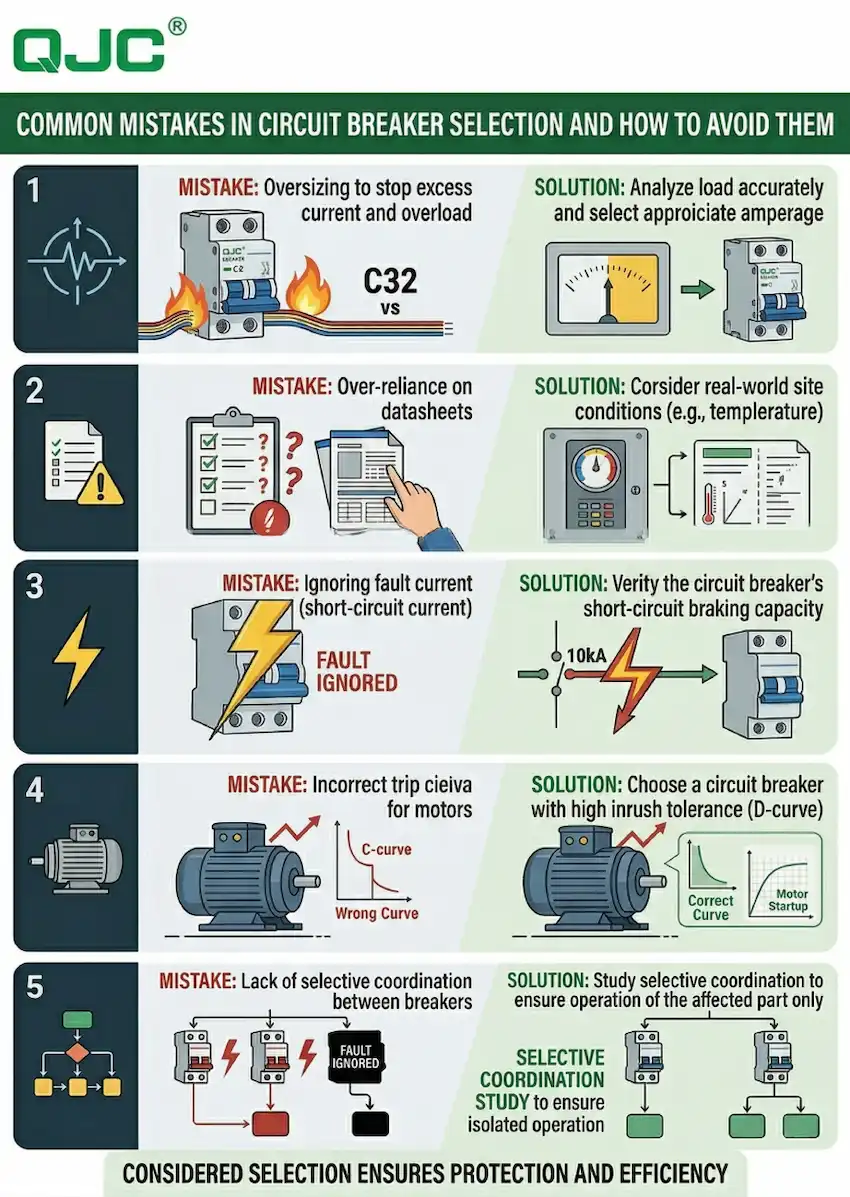
Common Mistakes When Selecting a Circuit Breaker and How to Avoid Them:
- Many people just look at the current and decide without thinking how the load actually behaves.
- Some increase the breaker size just to stop tripping, but they forget they are losing protection.
- Others go smaller to reduce cost, then face constant trips even in normal operation.
- Fault current is often ignored until a real short circuit happens and the breaker can’t handle it.
- Relying solely on datasheets is not enough, because site conditions are always different.
- Temperature inside the panel is usually forgotten, even though it affects performance clearly.
- A wrong trip curve with motors is very common, especially when startup current is high.
- No coordination between breakers means trouble; one issue can shut everything down.
- Skipping the right calculation for selecting circuit breakers leads to random choices, even if they seem correct.
Key Statistics on Circuit Breaker Failures and Selection Errors:
- Field studies show that a large portion of failures is linked to selection and application issues, not device defects.
- IEEE reliability practices confirm that system design and protection coordination are major failure contributors.
- In distribution networks, up to 80–87% of faults are transient, meaning breakers must be correctly selected to handle repeated interruptions, according to IEC and recloser studies.
- Studies on breaker operation show millions of switching cycles expose multiple failure modes, including thermal and mechanical stress.
- Nuisance tripping is widely reported in real installations, especially with electronic and motor loads.
- Fault current can be many times higher than rated current, and selecting a breaker below this level can lead to catastrophic failure.
Read More: Your Easy Guide to DC Surge Protective Device.
Key Standards and Safety Certifications Governing Circuit Breakers (UL, IEC, NEC):
- On-site, standards are not something you read once; you keep going back to them when decisions get tricky.
- Most engineers rely on IEC for international projects, particularly when systems are not region-specific.
- IEC standard circuit breaker ratings help you understand real limits, not just what looks acceptable on paper.
- UL shows up more when the project follows US specs or when the client asks for it directly.
- NEC is different; it’s less about the breaker itself and more about how everything is installed together.
- You can have a correctly selected breaker and still face issues, simply because installation rules were ignored.
- Standards don’t change how the breaker works internally, but they define how you are allowed to use it.
How to Select the Best Circuit Breaker Manufacturer?
- You don’t really judge a manufacturer from the datasheet; you judge them after the breakers run for a while.
- On paper, many brands look the same, but in operation small differences start to show.
- Consistency matters more than anything, especially when the same panel has multiple breakers.
- Some manufacturers keep their performance stable; others vary slightly from one batch to another.
- Technical data should actually help you decide, not just fill pages with numbers.
- If the data feels too clean or too perfect, double-check it; real devices are never that ideal.
- Certifications are useful, but only when they are traceable, not just printed on the catalog.
- In real projects, support matters when something doesn’t behave as expected, not before.
- Manufacturers like Qinjia-MCB are often considered when consistency and clear specs are required, especially in repeat installations.
- Replacement availability becomes important later, especially during maintenance.
Why QJC Is the Best Circuit Breaker Manufacturer?
In practice, what makes QJC noticeable is not a single feature, but how the breakers behave once installed and running. There is no need to keep adjusting expectations from one unit to another, and that alone saves time during testing and commissioning on real projects.
From a practical perspective, how to choose the correct circuit breaker is not only about numbers; it is about how much you trust those numbers. With QJC, the decision feels more straightforward because the behavior you expect is usually what you receive in operation.
Conclusion:
Ultimately, making the right choice boils down to a few practical facts:
- In practice, breaker selection becomes easier once you stop relying on assumptions and start working with real system values.
- Load behavior, fault level, and installation conditions are what actually drive the decision.
- Small mismatches that go unnoticed early lead to many problems.
- When you understand how to choose the correct circuit breaker, you start checking things differently without overthinking every step.
- Using sources like Qinjia-MCB also helps when the data you read matches what you see during operation, so you don’t keep adjusting your expectations after installation.
Still unsure about your selection? Reach out via our Contact Us page, drop us a message on WhatsApp, or email us at sales@dodgerblue-peafowl-108665.hostingersite.com for expert engineering support tailored to your system.
FAQs:
What is a Circuit Breaker?
Think of it as a guard. Everything runs fine; it stays on. Something goes wrong; it cuts the power. That’s it.
How Do I Know Which Amperage Rating to Choose for My Circuit Breaker?
You look at the load first. Then the cable. The breaker sits in between… not too high, not too low.
What is the difference between single-pole and double-pole circuit breakers?
Single handles one line. Double handles two together. Usually used when voltage or load is higher.
How do we know which circuit breaker to use?
You don’t guess it. You need to examine the system load type, current, and fault level. Then you decide.
How to choose the right size circuit breaker?
If it trips too much, it’s too small. If it never trips, it’s too big. The right size sits in the middle.





Leave a Reply