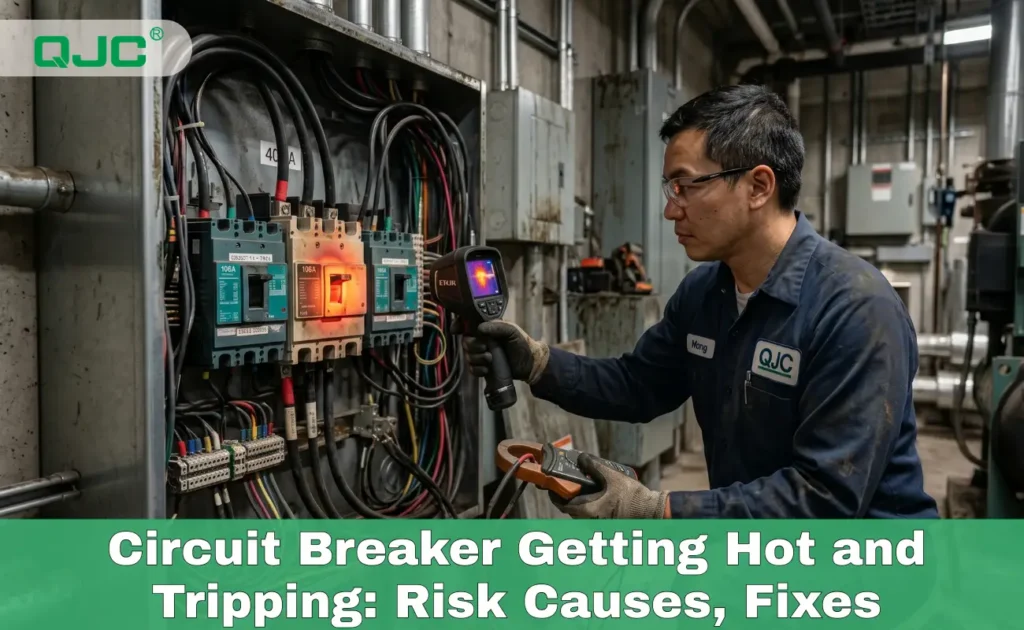
A circuit breaker getting hot and tripping is one of the most critical warning signs in any electrical installation, whether on a construction site, in an industrial facility, or inside a commercial building, as this issue threatens the entire electrical system with repeated failures and serious fire hazards, making it essential to understand the root causes and act quickly before a minor fault becomes a major catastrophe, especially for contractors and wholesale buyers who rely on high-performance breakers in demanding environments.
What Does It Mean When a Circuit Breaker Gets Hot and Trips?
When a circuit breaker getting hot and tripping occurs repeatedly, the internal thermal-magnetic mechanism is responding to either excessive current or an internal failure, disconnecting the circuit as a protective measure, and a recurring pattern is the signal that something deeper needs attention.
How the Tripping Mechanism Works?
A bimetal strip bends under overcurrent heat and triggers the trip, which is why distinguishing a load-induced trip from a defect-induced trip is critical before any reset attempt.
Read More: How to choose a device used to protect an electrical circuit?
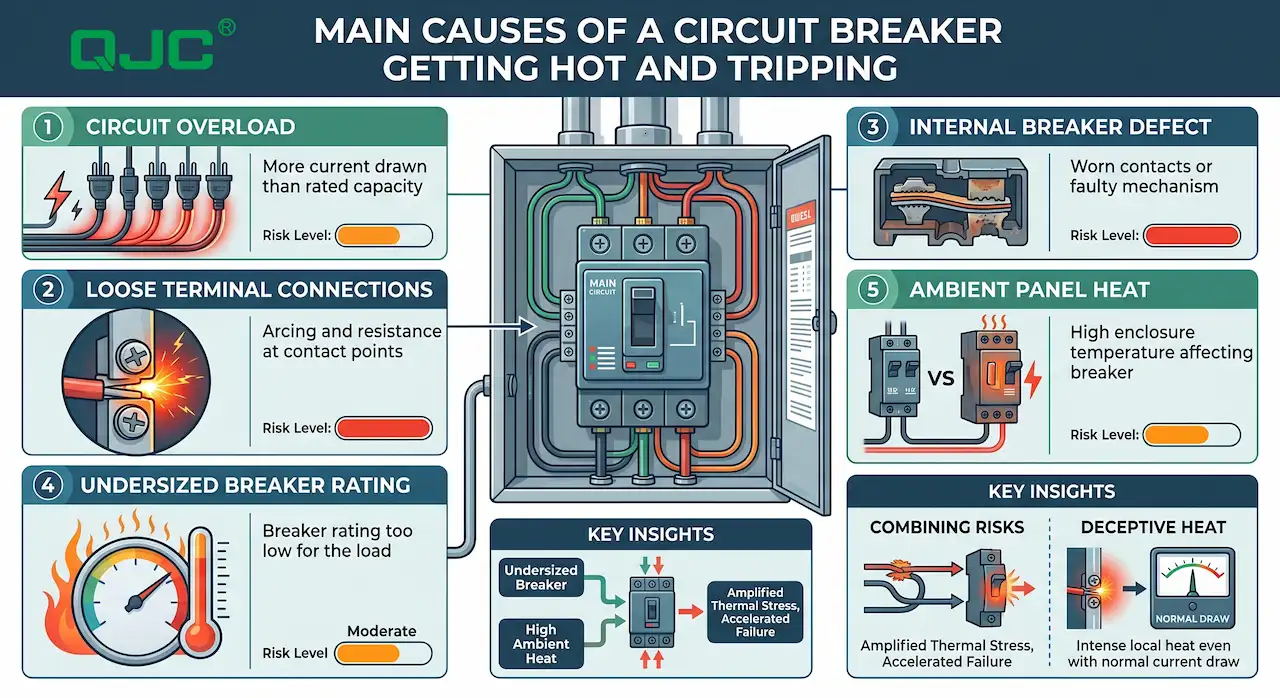
Main Causes of a Circuit Breaker Getting Hot and Tripping:
Understanding the root causes behind a main breaker getting hot and tripping helps technicians make informed decisions rather than resetting the breaker, which can mask a dangerous underlying problem.
| Cause | Description | Risk Level |
| Circuit overload | More current drawn than rated capacity | Moderate |
| Loose terminal connections | Arcing and resistance at contact points | High |
| Internal breaker defect | Worn contacts or faulty mechanism | High |
| Undersized breaker rating | Breaker rating too low for the load | Moderate |
| Ambient panel heat | High enclosure temperature affecting breaker | Moderate |
Each of the causes above can independently trigger a circuit breaker getting hot and tripping event, but in practice two or more factors often combine for example, an undersized breaker under elevated ambient heat which amplifies the thermal stress and accelerates failure, and loose terminal connections are particularly deceptive because they generate intense localised heat even when the current draw appears normal.
Normal Operating Warmth Versus Dangerous Overheating in Electrical Panels:
Not every warm breaker signals a problem, as all breakers generate some heat during normal operation, but knowing the threshold is essential for every site engineer: below 40°C is normal, 40–60°C is a caution zone requiring load inspection, and above 60°C is an immediate fire hazard requiring replacement.
| Temperature Range | Status | Action Required |
| ≤ 40°C | Normal operation | No action needed |
| 40–60°C | Caution zone | Inspect load immediately |
| ≥ 60°C | Fire hazard | Replace breaker immediately |
Ambient panel temperature plays a compounding role, as a breaker at 38°C inside an enclosure already at 35°C is under far more thermal stress than the surface reading suggests, which is why panel ventilation and enclosure ratings must be factored into any thermal assessment.
This is confirmed by IEEE Standard C37.13, which specifies that breakers operating above their rated ambient temperature must be derated to prevent premature failure and safety hazards.
How to Test if Heat Comes From Overload or an Internal Breaker Defect?
Diagnosing a circuit breaker getting hot and tripping requires isolating load-side issues from breaker-side failures, because treating one as the other leads to recurring problems and wasted costs, and circuit breaker getting warm and tripping is an early indicator that should never be ignored.
Step-by-Step Diagnostic Process:
- Use an infrared thermometer or thermal camera to measure the breaker surface temperature under normal load conditions.
- Measure the actual current draw using a clamp meter and compare it against the breaker’s rated ampacity.
- Inspect terminal screws for tightness, as loose connections can cause resistance heating even at normal current levels.
- Disconnect the load completely and allow sufficient time to cool, then check whether the breaker still feels hot, which would confirm an internal defect rather than a load-induced temperature rise.
- Check for discoloration, burn marks, or melted plastic around the breaker body as indicators of prior arcing.
- Compare heat distribution across adjacent breakers in the panel isolated heat on one breaker while others remain cool strongly points to an internal fault rather than a shared load issue.
According to the NFPA Electrical Fire Statistics Report 2023, electrical distribution and lighting equipment caused approximately 46,700 home fires annually, with overheating components among the leading contributors.
Read More: How to Choose the Correct Circuit Breaker for Your Project?
When to Replace a Hot Breaker Rather Than Resetting for Safety?
getting hot and tripping under fault conditions is not a nuisance — it is a component at the end of its reliable service life, and repeatedly resetting it accelerates internal wear and raises the risk of catastrophic failure, with consequences extending to personnel safety and project liability.
Replace the breaker immediately if any of the following conditions are observed:
- The breaker trips immediately upon reset even with no load connected.
- Visible burn marks, discoloration, or a burning smell from the panel.
- The breaker handle feels loose or does not latch securely in the ON position.
- Surface temperature exceeds 60°C under normal operating load.
- The breaker trips repeatedly without a clear load-side explanation, regardless of the number of occurrences.
IEC 60947-2 specifies that low-voltage circuit breakers must withstand a defined number of operating cycles before their interrupting capacity degrades, and repeated fault tripping accelerates this degradation significantly.
Read More: Which Company Circuit Breaker is Best for Projects?
Why Contractors and Wholesale Buyers Choose QJC Circuit Breakers?
breaker getting hot and tripping on a live site carries a cost in downtime, inspection time, and client trust, which is why QJC is the trusted choice for contractors, panel builders, and wholesale distributors where a main breaker getting hot and tripping is simply not an option.
- Precision thermal calibration: each breaker is calibrated to trip within tight tolerance bands, preventing nuisance trips and missed fault detection.
- Low-resistance contacts: silver alloy contacts minimize resistive heating at terminals under high sustained loads.
- IEC 60947-2 compliant: full compliance with international standards ensures predictable performance in global installations.
- Wide ampacity range: from 6A to 1600A to cover every application from residential panels to industrial switchgear.
- Bulk supply availability: QJC supports wholesale buyers with consistent inventory and competitive pricing per unit.
- Certified interrupting capacity: each unit is tested to its rated short-circuit interrupting capacity, ensuring reliable fault clearance without internal damage under worst-case fault conditions.
For contractors and wholesale buyers at scale, QJC’s consistency and traceability reduce field callbacks, warranty claims, and inspection failures that erode project margins.
Do you need expert technical advice or are you ready to upgrade your installations with reliable, high-performance breakers? Visit our Contact Us page, reach out directly via WhatsApp, or email us at sales@qinjia-mcb.com for bulk orders and exclusive wholesale pricing.
FAQ:
How to tell if overload or faulty breaker causes heat and trips?
The fastest test is to disconnect the load completely if the circuit breaker getting hot and tripping continues with no load, the fault is internal and replacement is required immediately.
Is it safe to keep resetting a hot breaker on a work site?
No repeated resetting of a hot breaker without diagnosing the root cause accelerates internal wear and significantly increases the risk of arc flash or fire.
What is the maximum breaker temperature before it becomes a fire hazard?
A circuit breaker getting hot and tripping alongside surface temperatures exceeding the manufacturer’s rated thermal limit, considering factors such as conductor temperature and insulation type, should be treated as a potential fire hazard and inspected immediately.




Leave a Reply